









Today is Sunday, June 7th. I had some free time in the morning and took a walk around the hotel. A 10-minute stroll brought me to the Danube River, where I admired the famous Széchenyi Chain Bridge linking Buda and Pest. Budapest gets its name from the two districts: Buda on the west bank and Pest on the east bank of the river.Most iconic buildings in Budapest date back to the era of the Austro-Hungarian Empire before World War I, a period when the empire stood powerful. The W Budapest Hotel where I stay has a history of 130 years. Featuring magnificent architecture and spacious rooms, it makes it easy to imagine the glory days of the Austro-Hungarian Empire. Right across the street stands the renowned State Opera House, a top tourist attraction in Budapest with an even longer history. Many tourists take photos here with their backs to the opera house.
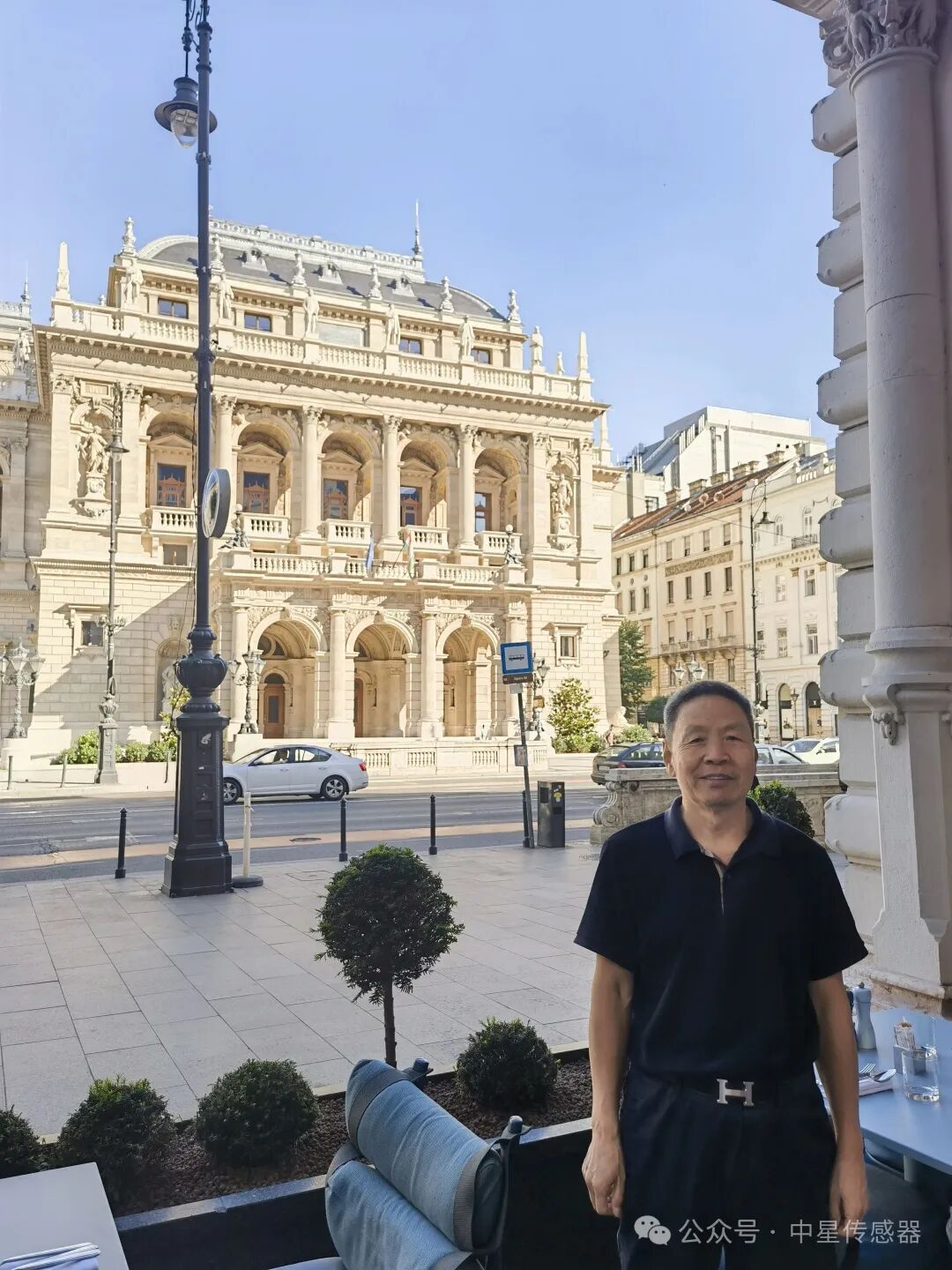
I met two young Chinese men in front of the opera house. They are permanent business staff of a Chinese state-owned enterprise stationed in Greece. Taking advantage of the weekend, they flew here from Greece in just two hours and booked tickets in advance to watch a Shakespearean opera. I can’t help but admire the lifestyle of young people nowadays.
In the afternoon, I visited the newly built factory of Wuhan Cubic Sensor and Instrument Co., Ltd. in Budapest, Hungary. As a listed company on China’s STAR Market, Cubic enjoys a leading market share and solid reputation for its optical gas sensors across China. Its high-end optical instruments developed with proprietary technologies also meet world-class quality standards and are exported to numerous countries. To better serve European clients, stay close to the market and respond to local demands, the company decided to set up this overseas factory in Budapest two years ago.
The Hungarian factory mainly targets major international automotive manufacturers. I talked with Mr. Yao, the local administrator, and Attila, the Hungarian factory director. They told me that running a factory in Hungary differs greatly from operating in China. A wide range of factors need to be taken into account, including environmental protection, fire safety, labor protection, local laws and regulations, employment rules, and even the load capacity of roads outside the industrial park.
Though Hungary is not among the most developed economies, its practices align with other European nations as an EU member. There are abundant public holidays. I heard the country observes three national day holidays every year, though I have not learned the exact reason. Combined with weekends, people enjoy roughly over 150 days off annually. Overall operating costs here are much higher than in China. It is said that pork prices are about 20% higher, while many vegetables cost three times as much as in Wuhan, China. I noticed that vegetable servings are quite limited at the buffet in my hotel, far fewer than those in most hotels back home, which I suspect is related to the high vegetable prices. #2026.06.07.21:08 W Budapest Hotel#
Through a friend’s introduction, I met a local Hungarian named David today. He drove me to visit four industrial parks around Budapest. Construction is in full swing across these parks. Unlike industrial parks in China, most factory buildings here are single-storey, with very few two-storey structures.
According to David, the price of industrial land around 80 to 90 kilometers from the city center is less than 30,000 RMB per mu, and the land comes with permanent property rights. Chinese-invested enterprises of various sizes can be found in nearly every park, engaging in the production of motors, metal structural parts and auto accessories.
The industrial parks are relatively scattered, yet all are served by public bus routes connecting to Budapest and nearby small towns, making commutes convenient for employees without private cars. Signs of Bank of China, Xiaomi mobile phone advertisements and Midea billboards can also be seen along the streets.
The automotive industry is one of Hungary’s pillar industries. An Uber driver told me that six major global automotive brands have manufacturing plants here, forming a complete industrial chain covering auto parts, plastic components and automotive sensors.
China’s Baolong Technology produces wheel speed sensors in Hungary. Cubic’s gas sensors and air quality sensors are also mainly targeted at the automotive sector. On behalf of Xi’an Chinastar M&C, I am here to explore new business opportunities and prospects.
After a busy day’s tour and struggling with jet lag, I feel quite tired. I will stop writing here and get an early rest. #2026.06.08.20:25 W Budapest#


