










Today, June 6th, I am flying to Budapest, the capital of Hungary. This is seemingly my first direct international departure from Xi’an. Previously, I always took connecting flights via ports such as Beijing, Shanghai, Shenzhen and Guangzhou.
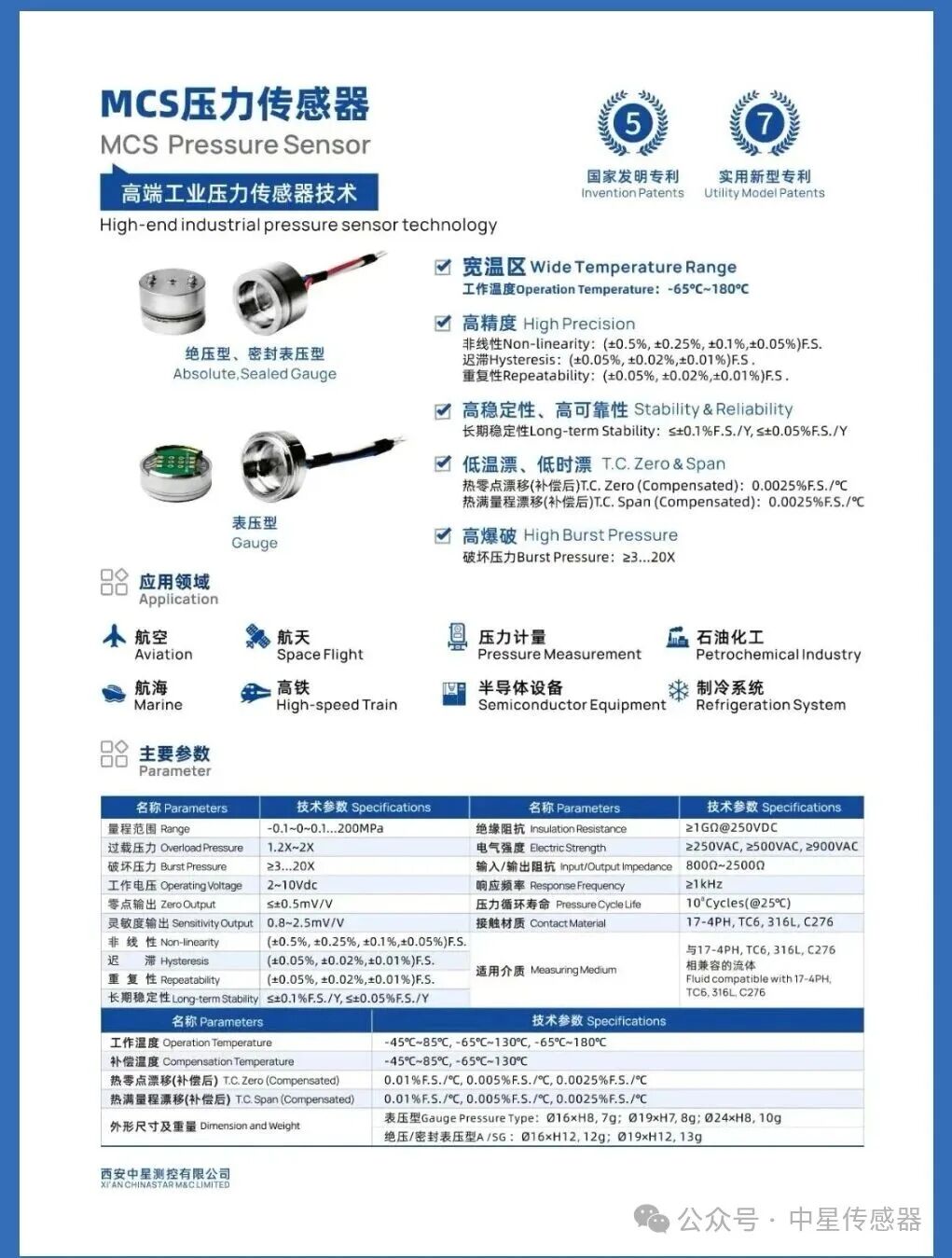
It may be because it is the weekend, or simply that it is around 10 a.m. The number of outbound passengers at Xi’an Customs is noticeably smaller than that at international ports in other cities. This makes me think Xi’an still needs to further elevate its international standing and airport classification. Recently, Xi’an Chinastar M&C has developed the high-end MCS pressure sensors. Featuring an oil-free sensing element, the product operates reliably at temperatures as low as -60°C, even down to -70°C, and up to 180°C. Our R&D team is also working on sensing elements that can withstand even higher temperatures.
To develop transmitters for wide temperature ranges, we face constraints from integrated circuits (ICs). Most standard ICs only work stably between -40°C and 85°C, while special models support a range from -55°C to 150°C. Low-temperature operation is relatively easy to solve: we can equip internal heating modules to raise the ambient temperature for ICs to function properly.
The real challenge lies in high temperatures. The conventional solution is to add a heat dissipation ring to separate the sensing element from the circuit assembly. However, this method delivers limited cooling effect and tends to increase the overall size and length of the device. Air conditioning systems come to mind for heat reduction, yet they take up excessive space. I wonder if any industry experts reading this article have compact solutions to cool down the circuit part of pressure transmitters and resolve overheating issues in high-temperature working environments.
There is one direct flight per week from Xi’an to Budapest, operated by a Boeing 787. The flight is fully booked today, indicating a large flow of travelers from China to Budapest. # 2026.06.06.12:18 Flight FM891 Xi’an – Budapest #
After boarding, I had lunch and rested for over an hour. I noticed an in-flight service card stating that Wi-Fi is available on this international flight. I followed the instructions to connect and found the service is free of charge. The network connection is unstable though, making it difficult to stream short videos, which is affected by satellite signals across different flight phases and regions.
While checking WeChat messages, I received a follow-up inquiry from a client on Douyin. They wanted further advice on how to detect occupied seats onboard a vessel.

From the perspective of wireless transmission and networking, this is a straightforward problem. The key is to select simple, practical and cost-effective sensors.
For instance, if we use load cells, how should we install them to keep costs low? If we adopt pressure sensors, how do we convert the pressure from a seated person into detectable signals?
When it comes to optical sensors, we need to choose between through-beam, diffuse reflection and photosensitive principles. It is always a trade-off between low cost and high reliability.
In the era of the Internet of Things (IoT), network technologies are well-established. By contrast, sensor technology is a mixed bag: mature in some aspects yet challenging in others, simple in theory but complicated in practical application. The core difficulty is to work out sensor solutions with high cost performance. We have to take into account the cost, power consumption and battery life of sensors, as well as installation costs for actual application scenarios.
Having worked in the sensor and IoT industry for years, I deeply realize that most practical problems are restricted by costs rather than technical solutions.
This is my first time using in-flight Wi-Fi, and the experience is unsatisfactory — probably because it is a free service. I tried five or six times to upload a photo for this official account post but failed repeatedly.
The speed is far below standard terrestrial networks. I look forward to the arrival of the 6G era, when seamless global connectivity and zero-time-lag communication will be realized everywhere.
# 2026.06.06.17:58 Flight FM891 Xi’an – Budapest


