









 Release Date:2026-07-15
  Click on the quantity:416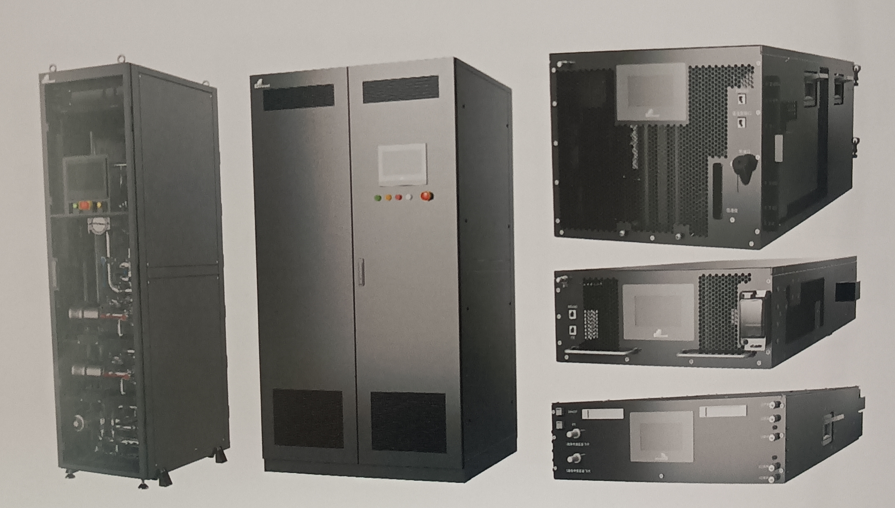
With the rapid deployment of AI large model facilities, high-density computing clusters and large-scale energy storage power stations, single rack power consumption has continuously broken through 50kW, 80kW and even 120kW. Restricted by air volume, noise and heat dissipation limits, traditional air cooling can no longer meet the demand for sustained and stable heat dissipation of ultra-high-power equipment. Boasting ultra-low PUE, silent operation, high heat dissipation efficiency and extended equipment service life, liquid cooling has become the standardized upgrade solution for intelligent computing centers, data centers and energy storage industries.
Liquid cooling CDUs, cold plate racks and energy storage thermal management circuits run continuously 24/7 all year round. Their pipelines face harsh operating conditions including water hammer shocks, high-humidity condensation and corrosion from ethylene glycol coolants. The sealing reliability and environmental adaptability of pressure transmitters directly determine the safe and stable operation of the entire cooling system. To meet full-scenario monitoring demands of liquid cooling systems, we recommend two core models: CS-PT300G1 and CS-PT1200.
Premium Option: CS-PT300G1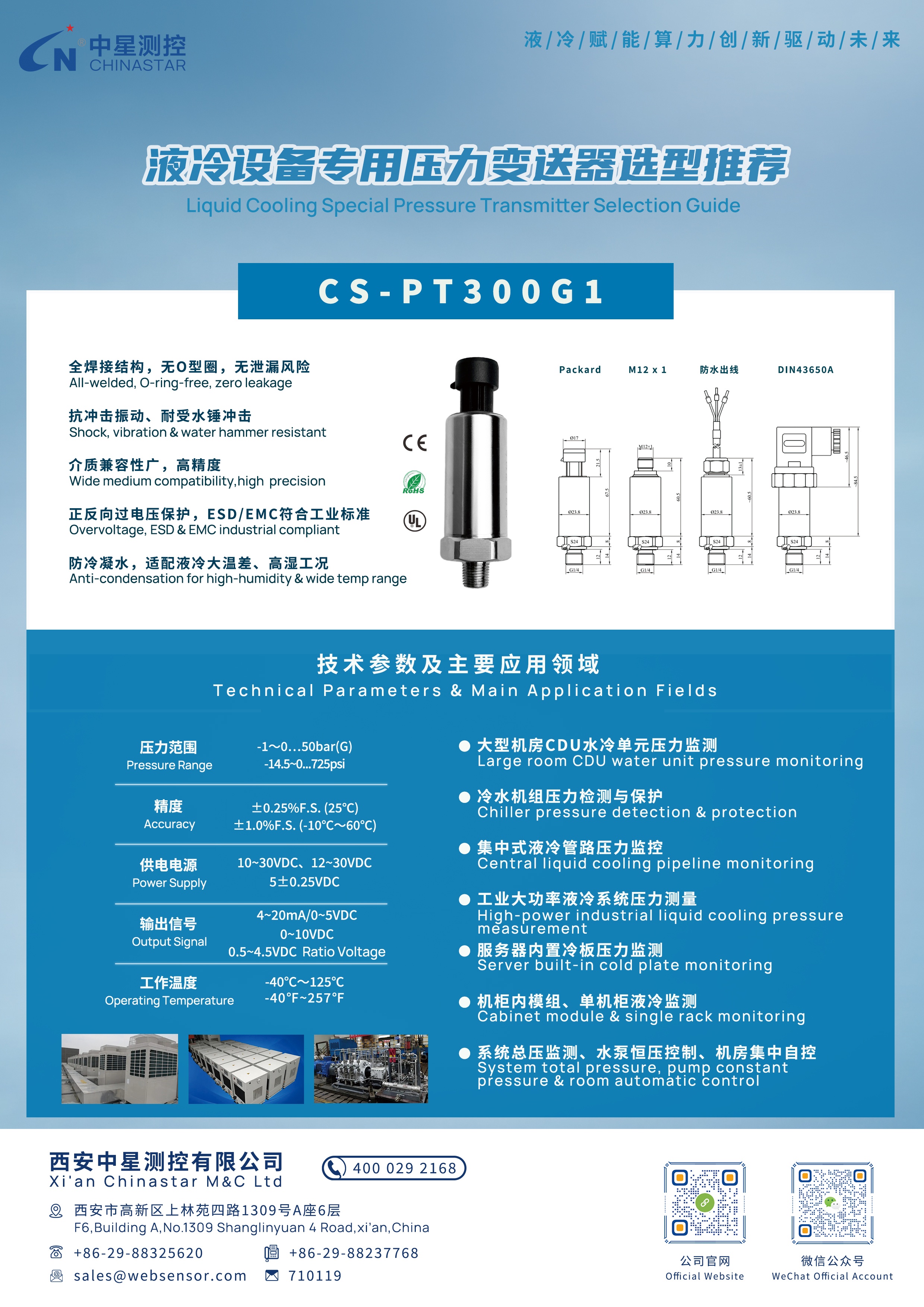
Developed exclusively for high-reliability liquid cooling scenarios, this model fits core monitoring points including main CDU loops, rack supply & return water headers and pump outlets. The fully integrated metal welded sealing structure eliminates rubber sealing components, fundamentally eradicating leakage risks caused by seal aging and fully complying with zero-leakage control standards of liquid cooling systems. Its wetted parts adopt 316L stainless steel, delivering outstanding medium corrosion resistance and stable compatibility with various liquid cooling media such as deionized water and ethylene glycol mixed coolants.
This transmitter features sufficient overload and burst resistance to withstand instantaneous water hammer shocks generated during pump startup and shutdown. Fully potted for waterproofing and equipped with a metal M12 industrial connector, it resists condensation, vibration and electromagnetic interference, making it suitable for long-term high-humidity complex environments in computer rooms. It delivers excellent long-cycle service life with minimal signal drift after years of continuous operation, drastically reducing on-site calibration and replacement frequency, and fits round-the-clock uninterrupted cooling systems in intelligent computing centers and large energy storage power stations. Multiple signal output options enable seamless connection with liquid cooling control cabinets and environmental PLC systems, supporting real-time pressure collection as well as early warning for pipeline blockage and medium leakage.
Standard Option: CS-PT1200
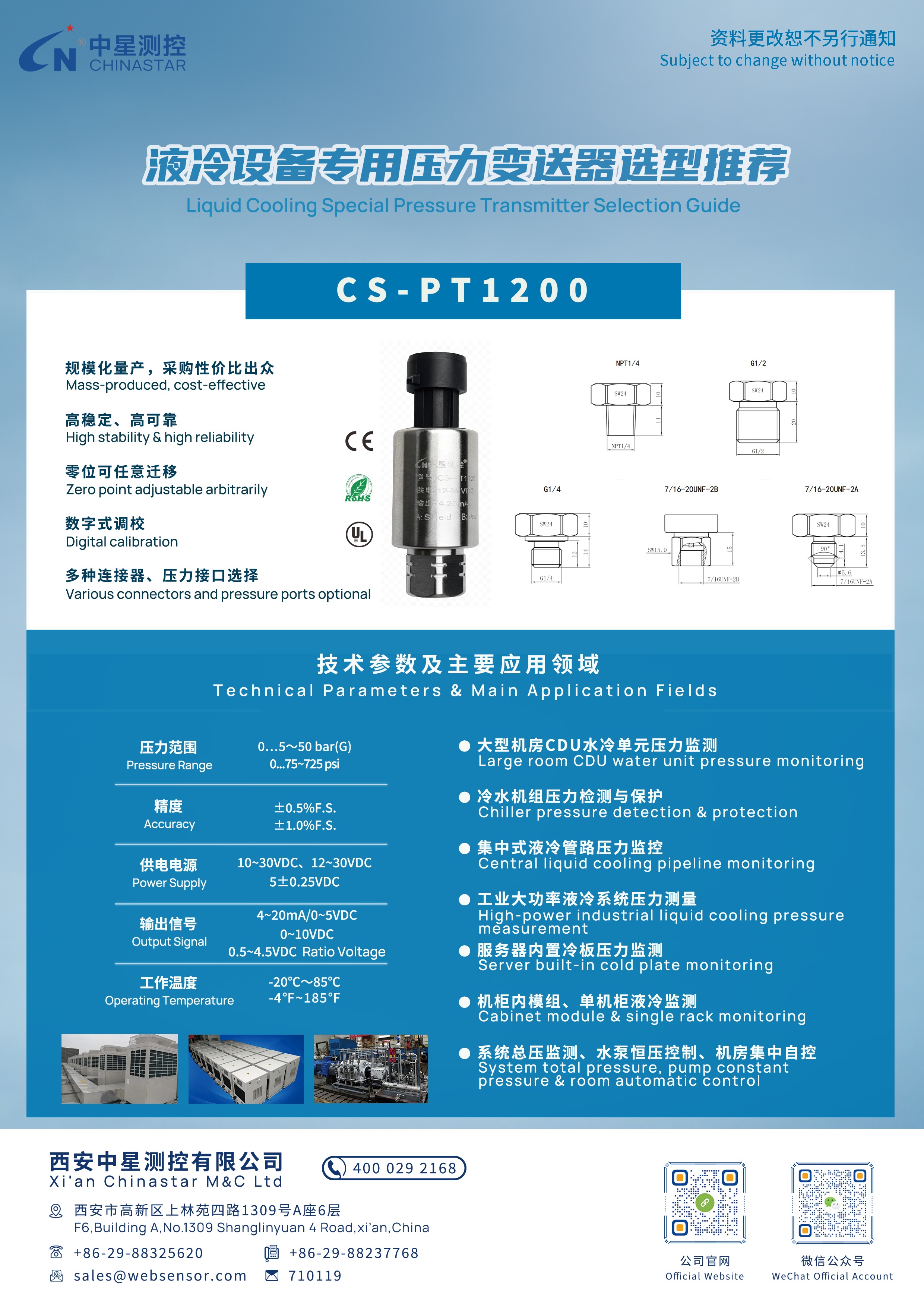
Designed for monitoring conventional liquid cooling branch lines and auxiliary pipelines to satisfy basic pressure acquisition requirements. Featuring a compact, streamlined structure for easy installation, it adapts to all types of small and medium-sized cold plate equipment and compact energy storage liquid cooling units. Its housing offers medium corrosion resistance compatible with standard ethylene glycol coolants, with standard industrial signal outputs that work with mainstream automatic control devices. Equipped with basic waterproof protection, it performs well in dry, low-impact conventional computer room environments and matches standardized liquid cooling equipment with moderate monitoring requirements.
Selection Guidelines
1. Prioritize CS-PT300G1 for large-scale intelligent computing centers, high-density AI racks, high-power energy storage CDUs, long-term continuous operation projects and applications with zero tolerance for leakage.
2. Choose CS-PT1200 for small & medium conventional liquid cooling equipment, auxiliary monitoring of rack branch lines and standardized equipment under mild impact working conditions.
Both models cover all pressure monitoring points across liquid cooling systems, including pump outlets, filter inlets/outlets and rack manifolds. They ensure stable and controllable pressure in liquid cooling loops and predict potential safety hazards such as pipeline blockage and medium leakage in advance.


