









A pressure sensor is essentially a device that converts mechanical deformation into electrical signals, and the Piezoresistive Effect is the physical foundation of this conversion. In 1856, Lord Kelvin (William Thomson), the renowned British physicist, first discovered that the electrical resistance of metals changes with mechanical strain. This groundbreaking finding ushered in a new era for humanity to perceive mechanical signals by leveraging the electrical properties of materials. Over the following century and more, scientists conducted in-depth research on the piezoresistive effect, gradually uncovering its physical essence and applying it to the design of various sensors. However, it was the discovery of the semiconductor piezoresistive effect that truly enabled the miniaturization and high performance of pressure sensors—silicon has a piezoresistive coefficient 50 to 100 times higher than that of metals. This enormous performance advantage propelled silicon-based pressure sensors to rapid development in the latter half of the 20th century, making them indispensable core components in industries such as manufacturing, automotive, medical care, and aerospace. The research and application of the piezoresistive effect have not only driven the advancement of sensor technology but also provided an important research platform for disciplines including solid mechanics, materials science, and semiconductor physics.

The physical mechanism of the piezoresistive effect can be deeply understood from the perspective of band theory in solid-state physics. When monocrystalline silicon is subjected to stress, its lattice structure deforms, leading to changes in the band structure and a subsequent variation in carrier mobility, which ultimately manifests as a significant change in resistivity. Unlike metallic materials, the piezoresistive effect in semiconductors mainly stems from the impact of stress on the effective mass of carriers and their scattering mechanisms. In monocrystalline silicon, the piezoresistive effect exhibits distinct anisotropic characteristics due to lattice symmetry. In-depth studies have shown that silicon achieves optimal sensitivity along the <111> and <110> crystal orientations—a property that provides crucial theoretical guidance for the optimized design of piezoresistive pressure sensors. Band theory analysis indicates that stress causes shifts in the energy positions of the conduction band minimum and valence band maximum, leading to the redistribution of carriers and thus altering the material's electrical conductivity. For p-type silicon, stress primarily affects the band structures of heavy and light holes; for n-type silicon, stress mainly causes energy splitting of the six equivalent energy valleys at the conduction band minimum.
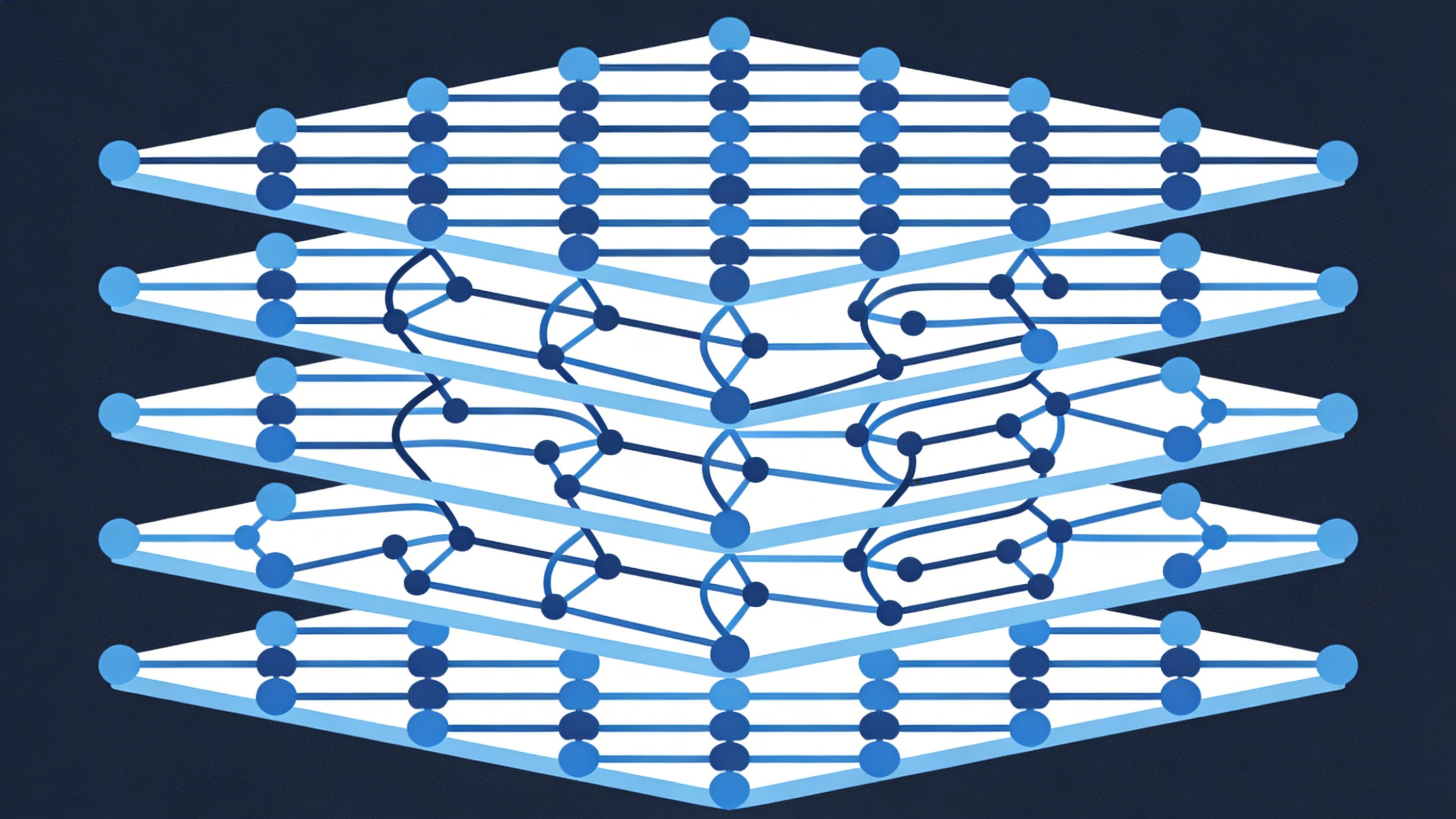
The piezoresistive coefficient, commonly denoted by the symbol π, is a key parameter describing the intensity of a material's piezoresistive effect. For monocrystalline silicon, there is a significant numerical difference between its longitudinal piezoresistive coefficient (πl) and transverse piezoresistive coefficient (πt), which depends on the relative orientation of the current and stress directions. At room temperature, the longitudinal piezoresistive coefficient of p-type silicon along the <110> crystal orientation can reach 71.8×10⁻¹¹ Pa⁻¹, while that of n-type silicon along the <100> crystal orientation is -102.2×10⁻¹¹ Pa⁻¹. These values are far higher than the typical value of metal strain gauges (approximately 2×10⁻¹¹ Pa⁻¹), fully demonstrating silicon's enormous advantages in piezoresistive sensing applications. The temperature dependence of the piezoresistive coefficient is also a critical factor to consider: generally, the absolute value of the piezoresistive coefficient decreases with increasing temperature, which explains why silicon piezoresistive sensors require temperature compensation. The piezoresistive coefficient is typically measured using the four-point bending method or cantilever beam method, determined by precisely controlling stress and measuring resistance changes.
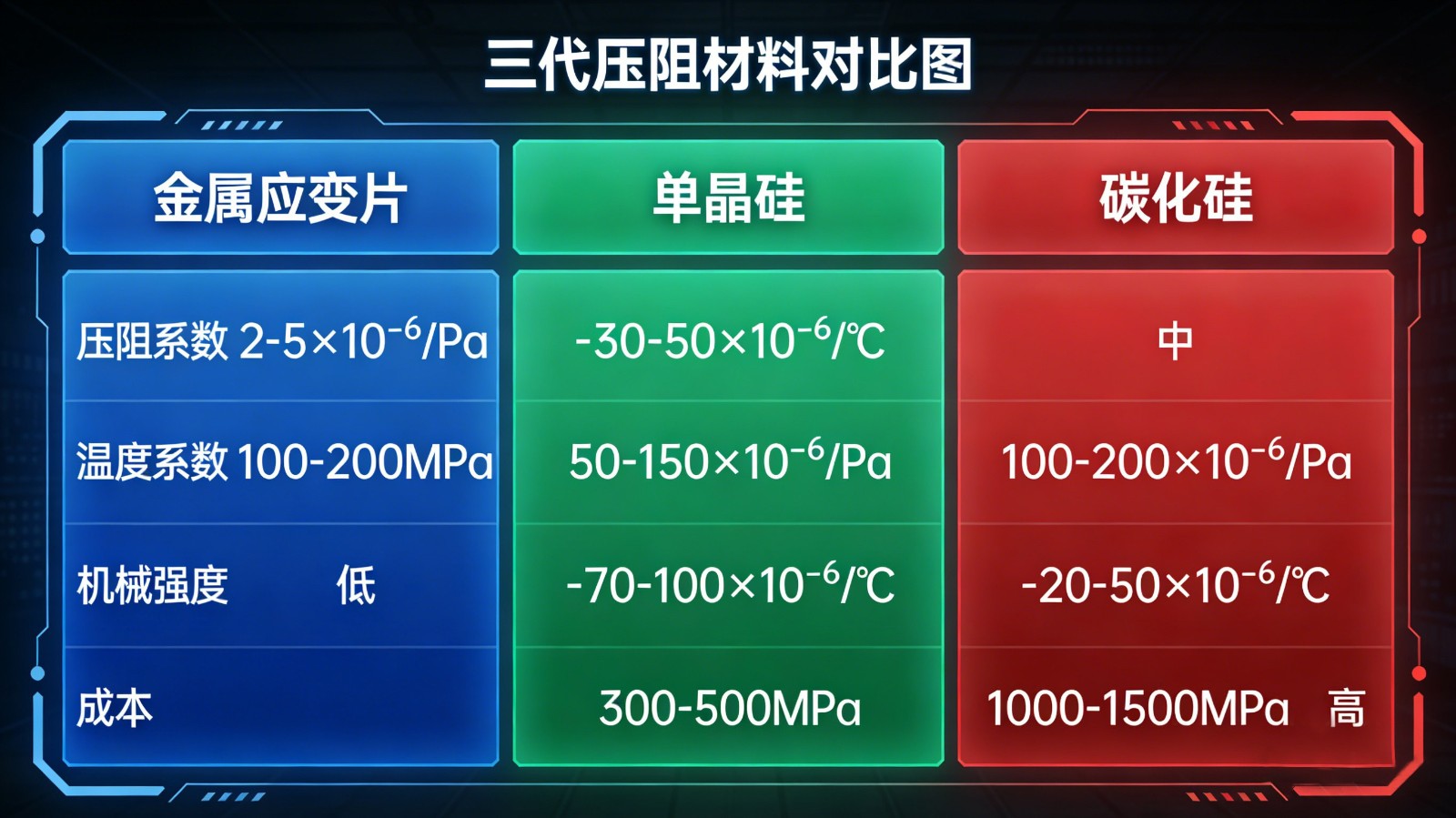
The evolution of piezoresistive sensing materials has gone through three important developmental stages. The first stage is the era of metal strain gauges, with the main materials including Constantan (a copper-nickel alloy) and Nichrome (a nickel-chromium alloy). These materials offer good stability and a low temperature coefficient but limited sensitivity (gauge factor, GF≈2), and are mainly used in industrial weighing and structural health monitoring with low precision requirements. The working principle of metal strain gauges is based on the geometric effect: when a material is stretched, its length increases and cross-sectional area decreases, leading to a rise in resistance. The second stage is the era of monocrystalline silicon, starting in the 1960s, when silicon's excellent piezoresistive properties were gradually recognized and utilized. Monocrystalline silicon features high sensitivity (GF≈100) but strong temperature sensitivity, requiring the integration of temperature compensation circuits. The third stage is the era of polysilicon and SOI technology. Polysilicon processes are highly compatible with CMOS processes, and their temperature coefficients can be adjusted via doping concentration; SOI (Silicon on Insulator) silicon technology delivers excellent high-temperature performance (up to over 300°C), making it particularly suitable for high-temperature applications such as aerospace and automotive engines. In recent years, wide bandgap semiconductor materials such as silicon carbide (SiC) and gallium nitride (GaN) have also attracted attention, offering higher operating temperatures and superior chemical stability.
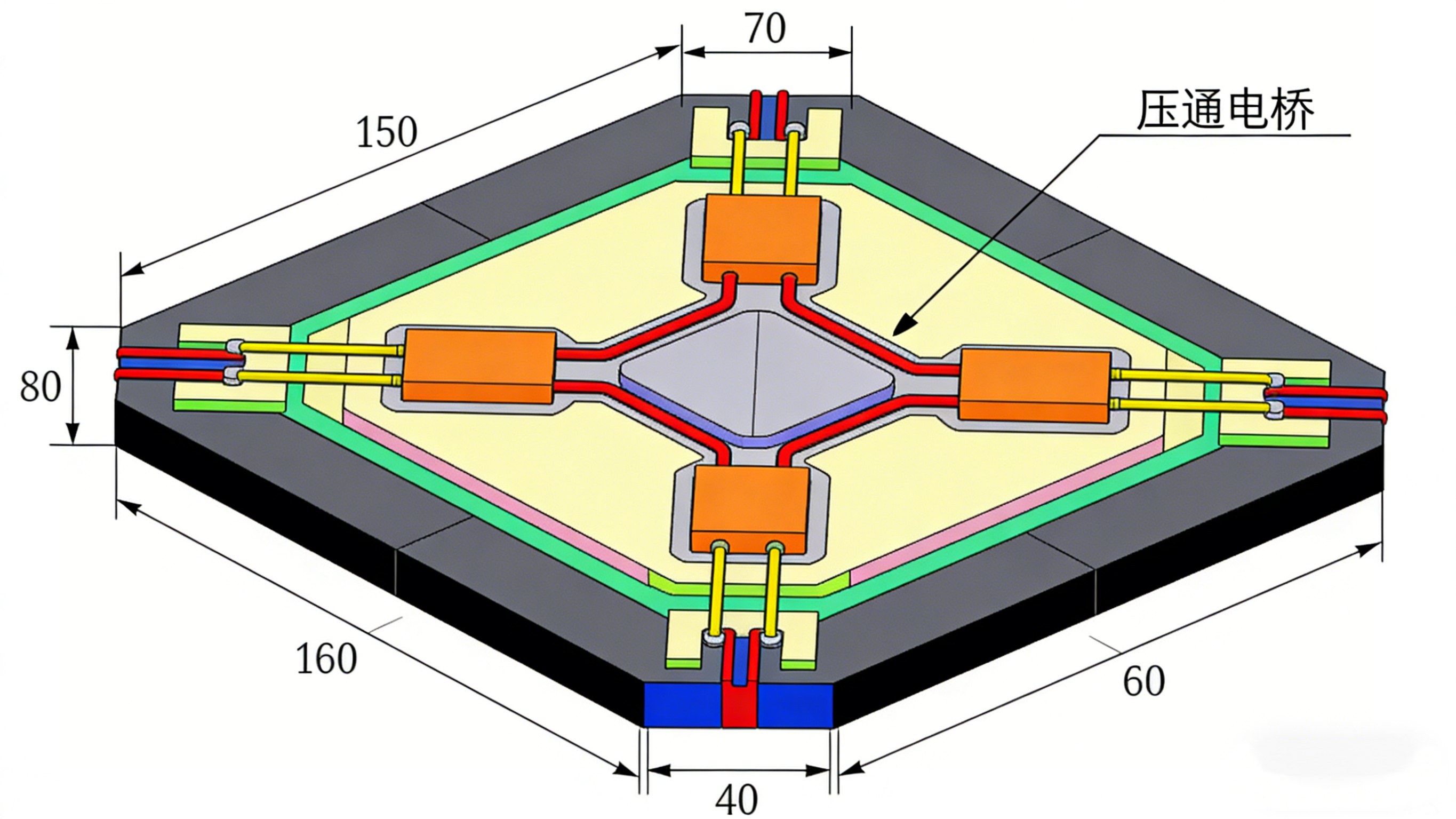
The core structure of a piezoresistive pressure sensor is a piezoresistive bridge on a silicon diaphragm. The key design principle is that the arrangement of piezoresistive strips must follow the stress concentration principle—they are typically placed at the edge of the silicon diaphragm, where stress distribution is uniform and the amplitude is large. Configured as a Wheatstone bridge, four piezoresistive strips form a full-bridge structure, which not only enables self-temperature compensation but also quadruples the sensitivity. Modern MEMS processes can fabricate piezoresistive strips with a width of 2–5 μm, achieving the unification of miniaturization and high sensitivity. In addition, the application of ion implantation technology allows precise control of the doping concentration and junction depth of piezoresistive strips, further optimizing sensor performance. A typical silicon diaphragm has a thickness of 10–50 μm and a diameter of 0.5–2 mm, fabricated through anisotropic etching or deep reactive ion etching (DRIE) processes. Diaphragms can be circular, square, or rectangular, with different stress distribution characteristics for each shape—optimized design is required based on application needs.
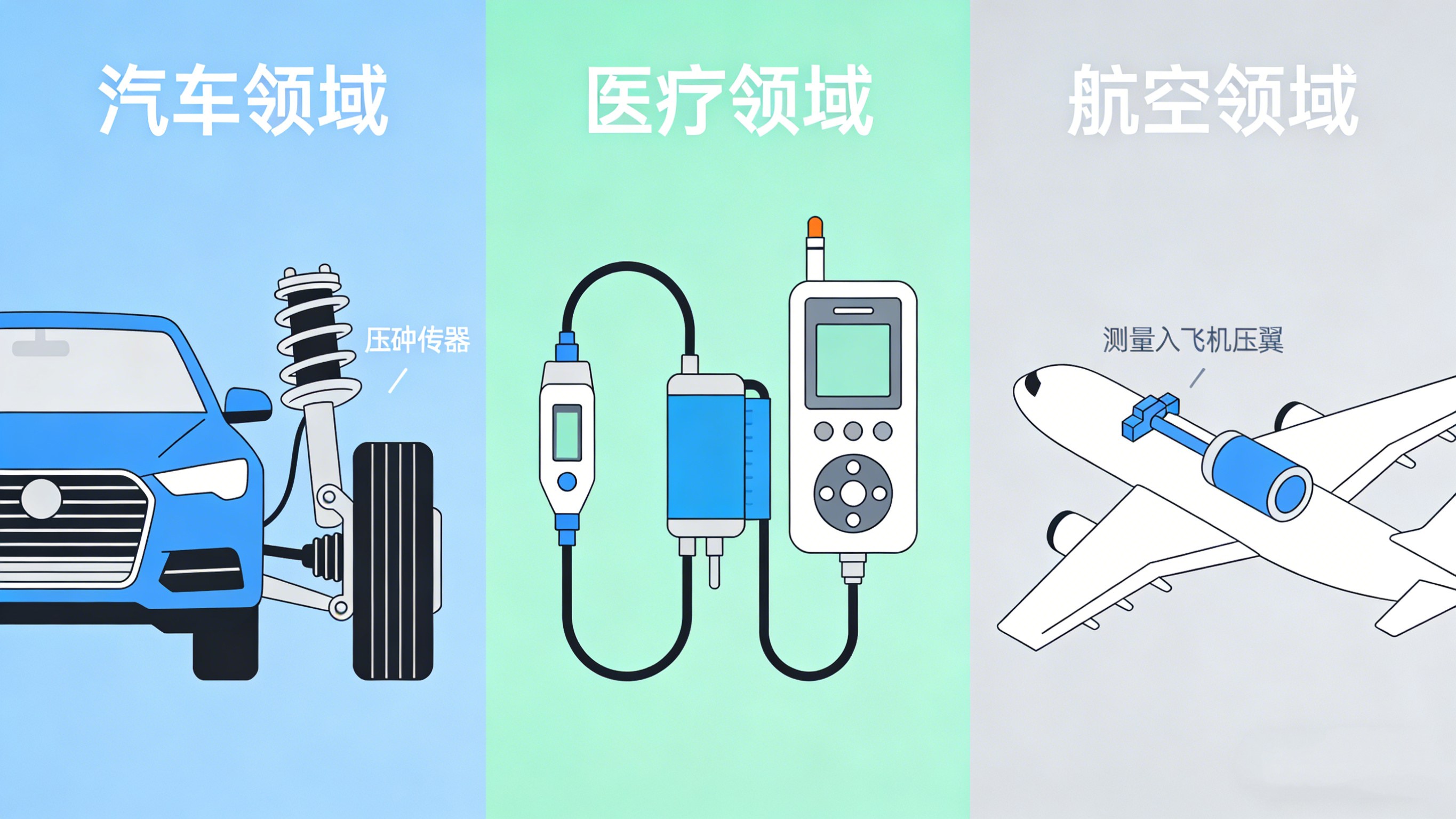
From an application perspective, piezoresistive pressure sensors have permeated all aspects of modern society. In the automotive industry, they are used in engine management systems (intake pressure, fuel pressure), Tire Pressure Monitoring Systems (TPMS), and braking systems (hydraulic pressure); in the medical field, they are applied in blood pressure monitoring, ventilator airway pressure monitoring, and infusion pump flow control; in industrial automation, they are utilized for process control, hydraulic system monitoring, and fluid metering. With the development of the Internet of Things and intelligent manufacturing, the demand for miniaturized, low-power, and high-precision pressure sensors continues to grow, and the piezoresistive effect, as the fundamental physical mechanism in this field, will become increasingly prominent. In the consumer electronics sector, barometers in smartphones are used for altitude measurement and indoor navigation, and pressure sensors in wearable devices for motion monitoring and health tracking. In the aerospace field, they are employed in key applications such as flight control systems, engine monitoring, and environmental control systems.
Future development directions include the research of new piezoresistive materials such as wide bandgap semiconductors like silicon carbide (SiC) and gallium nitride (GaN), which offer higher operating temperatures and better chemical stability; the exploration of the nanoscale piezoresistive effect, leveraging the unique electrical properties of nanomaterials such as graphene and carbon nanotubes; and the development of flexible piezoresistive sensors based on conductive polymers and nanocomposites, suitable for wearable devices and electronic skin applications. As the physical cornerstone of pressure sensing technology, the piezoresistive effect will continue to drive the development of sensor technology toward higher performance and broader applications. With the advancement of artificial intelligence and big data technology, intelligent pressure sensors will be capable of self-calibration, self-diagnosis, and predictive maintenance, providing key support for Industry 4.0 and intelligent manufacturing. The research and application of the piezoresistive effect will continue to make important contributions to humanity's exploration of the physical world and the improvement of quality of life. The piezoresistive effect can be mathematically described using the piezoresistive tensor. For silicon with a cubic crystal system, the piezoresistive tensor has specific symmetry, with only three independent non-zero components: π₁₁, π₁₂, and π₄₄. The longitudinal piezoresistive coefficient (πl) and transverse piezoresistive coefficient (πt) can be expressed using these three basic components, with specific expressions dependent on crystal orientation. Along the <100> crystal orientation: πl=π₁₁, πt=π₁₂; along the <110> crystal orientation: πl=(π₁₁+π₁₂+π₄₄)/2, πt=(π₁₁+π₁₂-π₄₄)/2. This anisotropic characteristic provides room for optimization in sensor design—optimal sensitivity can be achieved by selecting the appropriate crystal orientation.
The manufacturing process of piezoresistive pressure sensors includes multiple precise steps: silicon wafer cleaning, oxidation, photolithography, ion implantation, annealing, metallization, passivation, and etching. Each step requires strict control of process parameters to ensure the performance and consistency of the final product. Ion implantation is the key step for forming piezoresistive strips; implantation energy and dose determine the doping concentration and junction depth, which affect the resistance value and temperature coefficient of the strips. Annealing is used to activate implanted impurities and repair lattice damage; the annealing temperature and time need to be optimized for optimal electrical performance. Metallization forms electrodes and interconnections, typically using aluminum or gold; consideration must be given to contact resistance with silicon and long-term reliability.
In practical applications, several critical performance indicators must be considered for piezoresistive pressure sensors. Non-linearity is the degree of deviation from a linear relationship between the sensor's output and input pressure, usually expressed as %FS. Hysteresis is the difference in output values during the pressure increase and decrease processes at the same pressure point, reflecting the elastic hysteresis characteristics of the material. Repeatability is the consistency of output values when measuring the same pressure point multiple times under identical conditions. These performance indicators collectively determine the comprehensive precision and reliability of a sensor. High-end piezoresistive pressure sensors can achieve a total error of non-linearity, hysteresis, and repeatability of better than 0.1%FS, meeting the requirements of high-precision measurement applications.


